


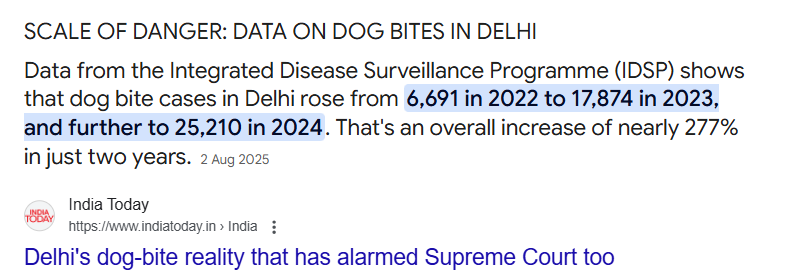
The National Capital Region (NCR) of Delhi is facing a growing human–dog conflict, driven by rising incidents of stray dog attacks and persistent fears of rabies. According to the National Centre for Disease Control (NCDC), over 37 lakh dog bite cases were reported in India in 2024. In Delhi alone, 35,198 animal bite incidents were recorded between January and June 2025. This marks a worrying trend, with official data showing that dog bite cases in the capital rose from 6,691 in 2022 to 25,210 in 2024 — a staggering 277% increase in just two years.


The Supreme Court’s Landmark Intervention
On August 11, 2025, the Supreme Court took suo motu cognisance of escalating stray dog attacks, particularly targeting children and the elderly. In a landmark directive, Justices J. B. Pardiwala and R. Mahadevan ordered the complete removal of stray dogs from Delhi-NCR within eight weeks, relocating them to shelters and prohibiting their release back into public spaces. The court emphasised that “infants and young children should not fall prey to rabies” and prioritised public safety over the Animal Birth Control (ABC) Rules.
The ABC Rules Debate
The ABC Rules (2001, updated 2023) were introduced to manage stray dog populations humanely — through sterilisation, vaccination, and release back into their original locations. However, critics argue that this approach has failed, as sterilised and vaccinated dogs can still bite, kill, or cause accidents. Feeding strays in public spaces has also increased territorial aggression. The rules even prevent euthanasia of visibly rabid or dangerous dogs, often resulting in their release back into the same neighbourhoods where attacks occurred.
Supporters of the ABC Rules see them as a compassionate alternative to culling and believe their failure lies in poor implementation rather than in the policy itself. They argue that better funding, awareness, and coordination with local authorities could improve results without resorting to mass removal.
Balancing Human and Animal Rights
This is where the debate becomes deeply emotional. Animal lovers point out that stray dogs are also victims — of abandonment, neglect, and lack of proper care. They fear that mass removal may lead to cruelty, overcrowded shelters, or even illegal culling.
On the other hand, victims’ families and public safety advocates highlight the devastating human cost: children mauled while playing, delivery workers attacked on duty, and daily wage labourers losing crucial workdays to recover from injuries. In many tragic cases, rabies infection has led to preventable deaths — India accounts for 36% of global rabies fatalities.
Learning from Global Practices
Globally, stray dog management policies are stricter. The US and most of Europe impound and euthanise unclaimed dogs. Australia shoots feral dogs to protect biodiversity, and the IUCN lists stray dogs as an invasive species requiring control and eradication. These policies focus on preventing suffering for both humans and animals — recognising that uncontrolled stray populations harm both.
A Call for Practical Compassion
The Supreme Court’s ruling signals the end of a 25-year experiment with the ABC Rules in their current form. The challenge now is to design a system that protects human lives without abandoning compassion for animals. Shelters must meet humane standards, sterilisation programs should continue for owned and sheltered dogs, and adoption initiatives should be promoted.
This debate is not about choosing between humans and animals — it’s about preventing unnecessary suffering for both. As Mahatma Gandhi once said, “Roving dogs do not indicate compassion and civilisation in society; instead, they betray the ignorance and lethargy of its members.” True compassion means creating a safe, healthy environment for all — humans and animals alike.