


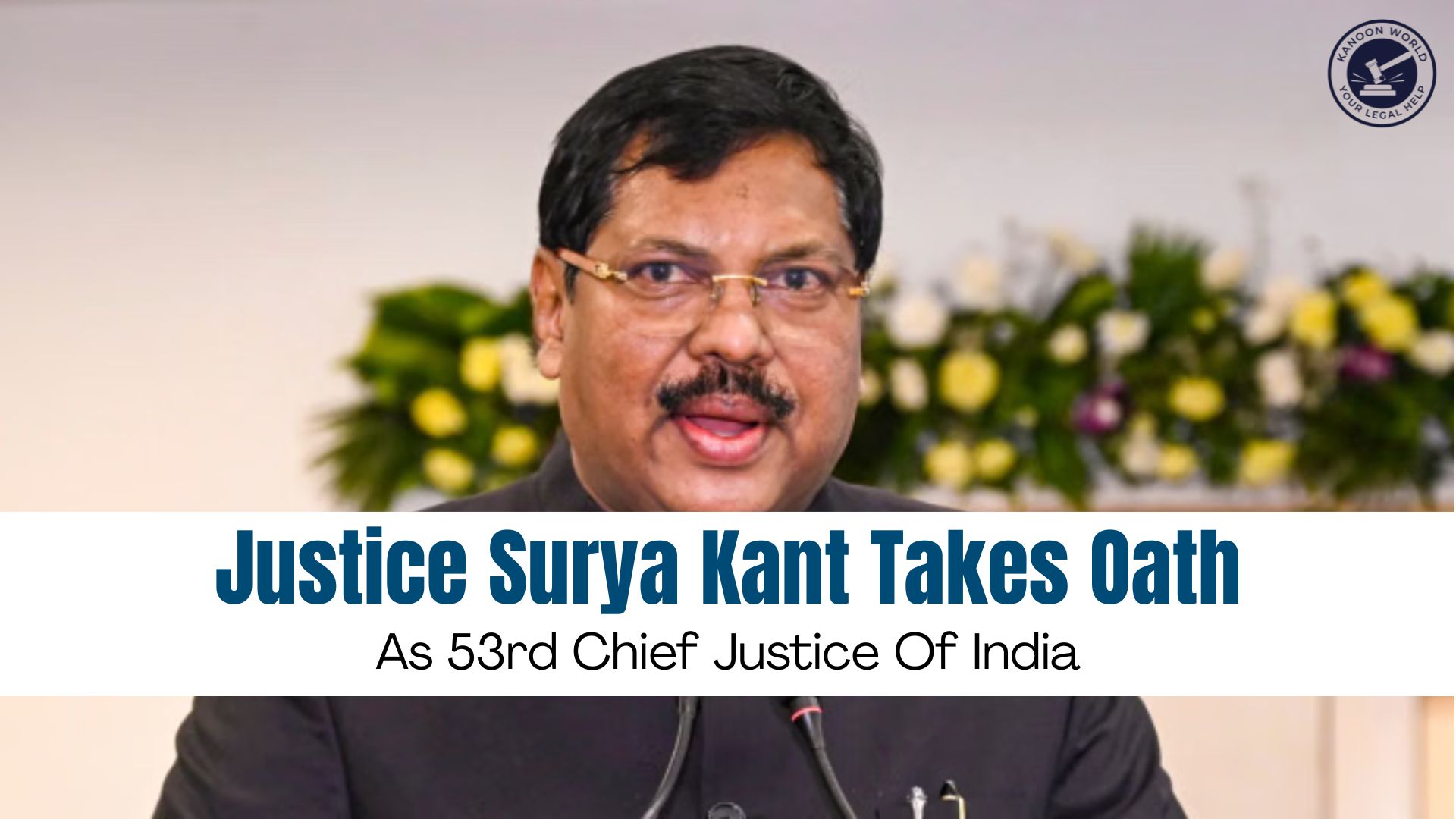
Kant sworn in as the 53rd CJI; all eyes on pendencies, SIR case
Chief Justice Surya Kant has said his topmost priority would be to bring the pendency of over 90,000 cases in the top court to a manageable number
Justice Surya Kant took oath as 53rd Chief Justice of India at the Rashtrapati Bhawan on Monday (November 24, 2025).
President Droupadi Murmu swore in Justice Kant merely days after Justice Kant, as a member of the 16th Presidential Reference Bench, advised her that neither she nor the State Governors, while dealing with State Bills, are bound by timelines “imposed” by the Supreme Court as in the April 8 judgment in the Tamil Nadu Governor case.
Both Chief Justice Kant and his immediate predecessor, Justice B.R. Gavai, was recently lauded by Solicitor General Tushar Mehta for bringing “Indianness” in the courts. Mr. Mehta, in his address, highlighted that their judgment did not refer to foreign precedents of law and drew their reasonings from Indian case laws and legal principles in their verdicts.
Chief Justice Kant was appointed to the Supreme Court on the same day as Justice Gavai, on May 24, 2019.
Act of camaraderie
After the oath ceremony, in an act of camaraderieship and respect for the office, Justice Gavai reserved the official vehicle designated for the Chief Justice of India for Chief Justice Kant, ensuring that his successor’s maiden journey to the Supreme Court as CJI was in the official car itself.
The Chief Justice is seen as a judge who leans more towards gently nudging disputes to a resolution over time rather than taking a confrontational approach. Justice (as he was then) Kant had resolved the farmers’ agitation from the Bench by prodding both sides — the protesting farmers and the Union government — to the negotiating table at a critical point when matters were spiralling with farmers’ leaders on an indefinite strike on the borders of Delhi.
Justice Surya Kant takes charge as India’s 53rd CJI
A brief timeline
Feb. 10, 1962
Born in Petwar village, Hisar district, Haryana
1984
Earns his law degree from Maharishi Dayanand University, Rohtak, Haryana
1984
Begins legal practice at the District Courts in Hisar, Haryana
1985
Shifts to the Punjab and Haryana High Court in Chandigarh, specialising in constitutional, service, and civil matters
July 7, 2000
Earns the distinction of being appointed the youngest Advocate General of Haryana. Designated as a Senior Advocate.
Jan. 9, 2004
Elevated as a permanent judge of the Punjab and Haryana High Court
2007 to 2011
Serves on the Governing Body of the National Legal Services Authority (NALSA)
2011
Earns a First Class First in his Master’s degree in Law
Oct. 5, 2018
Appointed Chief Justice of the Himachal Pradesh High Court
May 24, 2019
Elevated to the Supreme Court of India
Since May 14, 2025
Serves as the Executive Chairman of NALSA and on several committees of the Indian Law Institute
Nov. 24, 2025
Sworn in by President Droupadi Murmu as the 53rd Chief Justice of India. He retires on February 9, 2027.
Chief Justice Kant’s tenure would be closely watched for his handling of the Special Intensive Revision (SIR) case. So far, the judicial interventions of his Bench have made the SIR procedure accessible to citizens. But it is yet to take up the basic issue of whether the exercise itself is constitutional or not. Meanwhile, the SIR has expanded from Bihar to its second phase to 12 States and Union Territories and covering 51 crore people.
Dividing line between humour and perversity
Chief Justice Kant was seen to draw a sharp dividing line between humour and perversity while hearing the case of Youtuber Ranveer Allahbadia, who had approached the apex court for Protection against arrest over his comments about parents and sex in the show ‘India Got Latent’.
“Humour is an art. Humour is something that the entire family can enjoy and nobody feels embarrassed. That is talent. Using filthy language is not talent. Talent is using ordinary words to produce humour. We have excellent comedians in Bollywood. Writers of humour,” Justice Kant had given his take on what humour ought to be really.
The judge had also constituted a panel of senior IPS officers to comb through the social media posts of academician Ali Khan Mahmudabad to pick out the nuances in his contentious social media posts on Operation Sindoor.
Part of several impactful decisions
Justice Kant has been a part of several impactful decisions of the apex court, including the abrogation of Article 370 of the Constitution which removed the special status to the erstwhile State of Jammu and Kashmir. Justice Kant was also part of the Bench which held the electoral bonds scheme unconstitutional. He was a member of the Benches which heard the Pegasus spyware case and suspension of the sedition law. A Bench headed by him had afforded Ashish Mishra, the son of a former Union Minister accused in the Lakhimpur Kheri killings case , interim bail subject to stringent conditions though the Allahabad High Court had denied the man relief.
The Chief Justice, who has a tenure of little over a year till his retirement on February 2, 2027, has said his topmost priority would be to bring the pendency of over 90000 cases in the top court to a manageable number. Lately, judges have been commenting on how parties, especially influential ones, tend to repeatedly return to the Supreme Court with “miscellaneous applications” questioning or seeking “clarifications” on binding judgments, thus prolonging litigation and adding to the pendency graphics. The court has also become the first forum to approach for many who bypass the State High Courts.
A Bench led by Justice Kant had recently said it was the Chief Justice of India’s prerogative to examine the contentious issue of “a most revered member of the judiciary” approaching a judicial member of the NCLAT, Justice (retired) Sharad Kumar Sharma, for a favourable decision in a pending case. Justice Kant, as the new CJI, would be expected to take a call on that now.
It is also to be seen if Chief Justice Kant would take forward and further act on allegations of hate speech against sitting High Court judge, Justice Shekhar Yadav. Justice Gavai had said “we tried our best”. It is also to be seen if the Kant Collegium would reach a consensus on recommending women judges to the Supreme Court Bench.
Chief Justice Kant was born on February 10, 1962 at Hisar in Haryana. He was the youngest Advocate General of Haryana on July 7, 2000 and elevated as a judge of the Punjab and Haryana High Court on January 9, 2004. Justice Kant was appointed as the Chief Justice of the High Court of Himachal Pradesh in October, 2018.
